
Key takeaways
- What looks like independent services often turns into coordination work as boundaries blur.
- Before changing the system, clarify ownership, dependencies, and whether team boundaries match system boundaries.
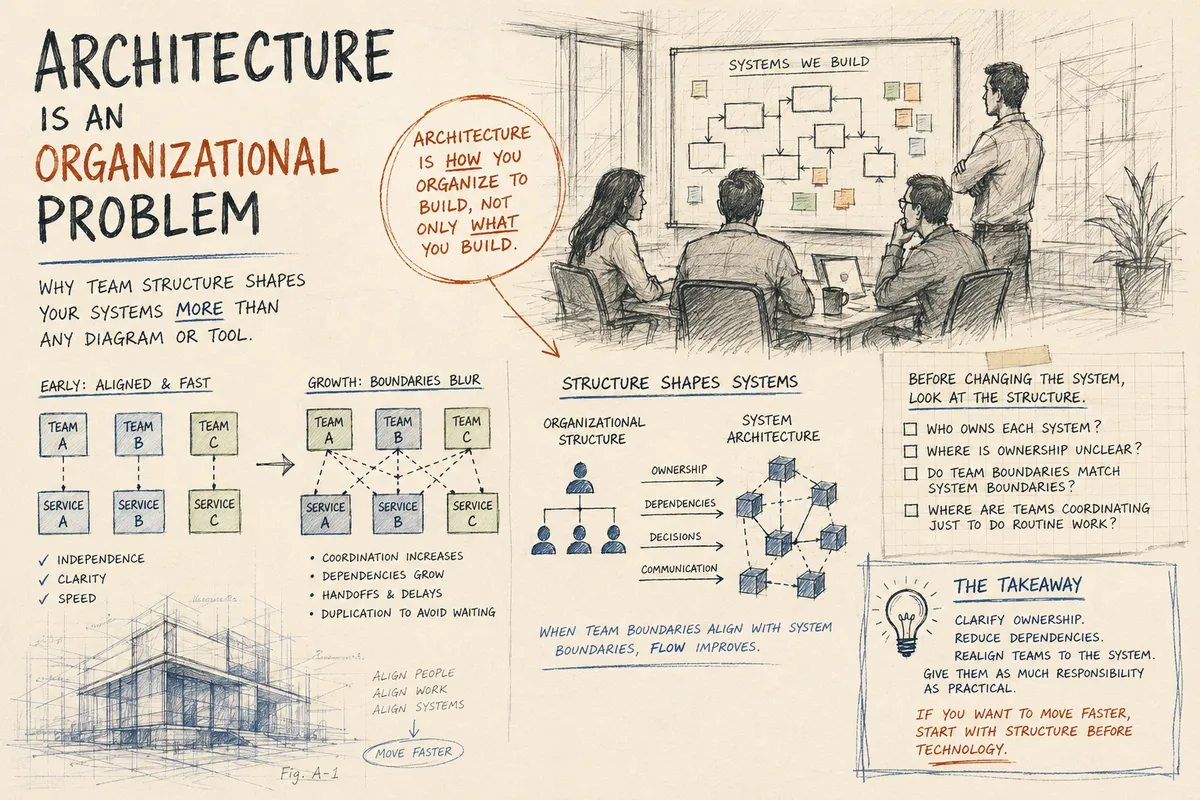
- Architecture is how you organize to build, not only what you build.
Architecture is not just technical. It’s how your organization operates. Team structure shapes how systems evolve more than any tool or diagram.
I’ve seen this play out in a familiar way. Teams are organized by feature area, each of which owns a service. Early on, this works well. Decisions stay local, releases are fast, and progress is clear.
But as the product grows, features start to cross those boundaries. Teams begin to rely on each other, and what felt like independence turns into coordination. Over time, most of the work becomes managing that coordination.
At first, it’s manageable. A few messages, a quick meeting. Then it grows into planning, handoffs, and delays. Teams may even duplicate work just to avoid waiting. Nothing technically failed. The system simply reflected the organization’s structure.
Before changing the system, look at the structure. A quick review helps:
Who owns each system?
Where is ownership unclear?
Do team boundaries match system boundaries?
Where are teams coordinating just to do routine work?
When the gaps are visible, you can adjust. Clarify ownership, reduce dependencies, and realign teams to the system and give them as much responsibility as practical. If you want to move faster, start with structure before technology.
Architecture isn’t just what you build. It’s how you organize to build it.