You can’t scale delivery without understanding your constraint.
AI agents create the feeling of unlimited capacity. There’s always another task to start. It feels like progress, even though the system may not actually be moving faster.
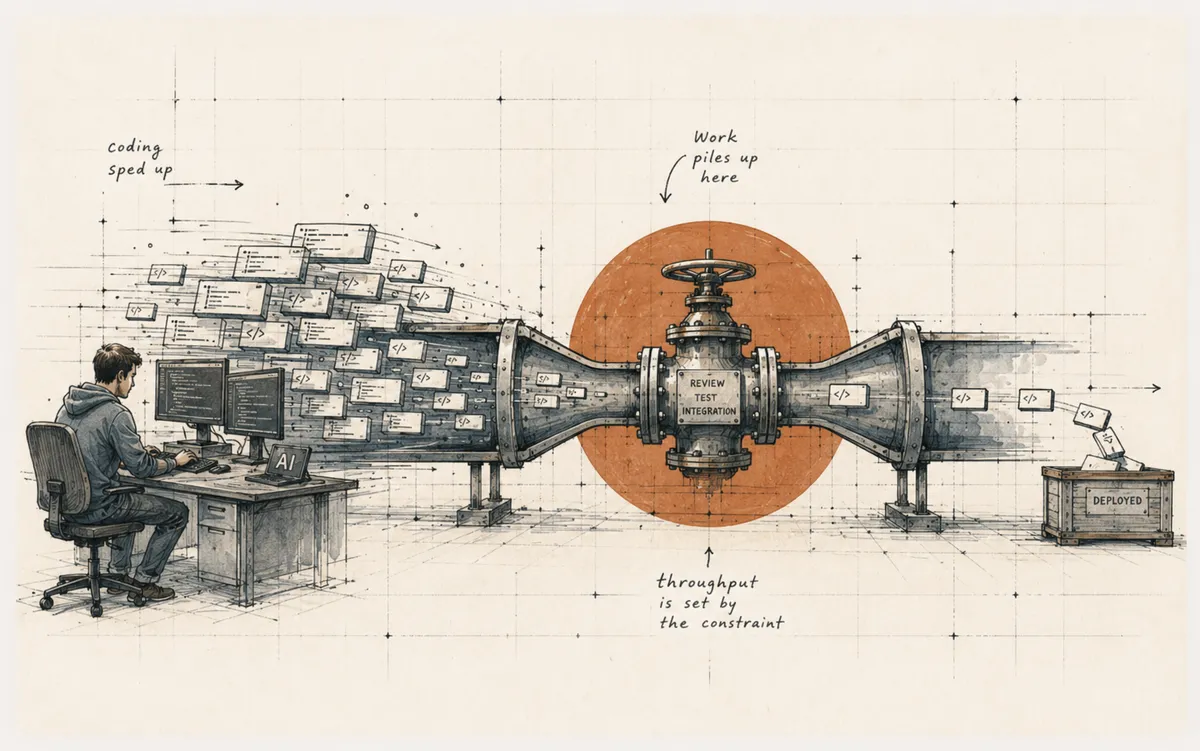
In The Goal by Eliyahu M. Goldratt, the idea is simple: every system has a constraint, and that constraint determines output. Improving anything else doesn’t increase throughput.
If you’re just using AI for coding, you may be increasing capacity where the constraint isn’t. If coding was the constraint, speeding it up could simply shift the bottleneck elsewhere.
So more work enters the system. More work starts, and more piles up in front of whatever is actually limiting progress. Delivery may not speed up. It could slow as work backs up at the constraint.
Most teams started by applying AI to code, and are now (or still) feeling the bottleneck elsewhere. It makes sense that they’re now looking to apply AI across the entire SDLC. Rather than taking it all on at once, I recommend starting with the biggest constraint and moving from there.